
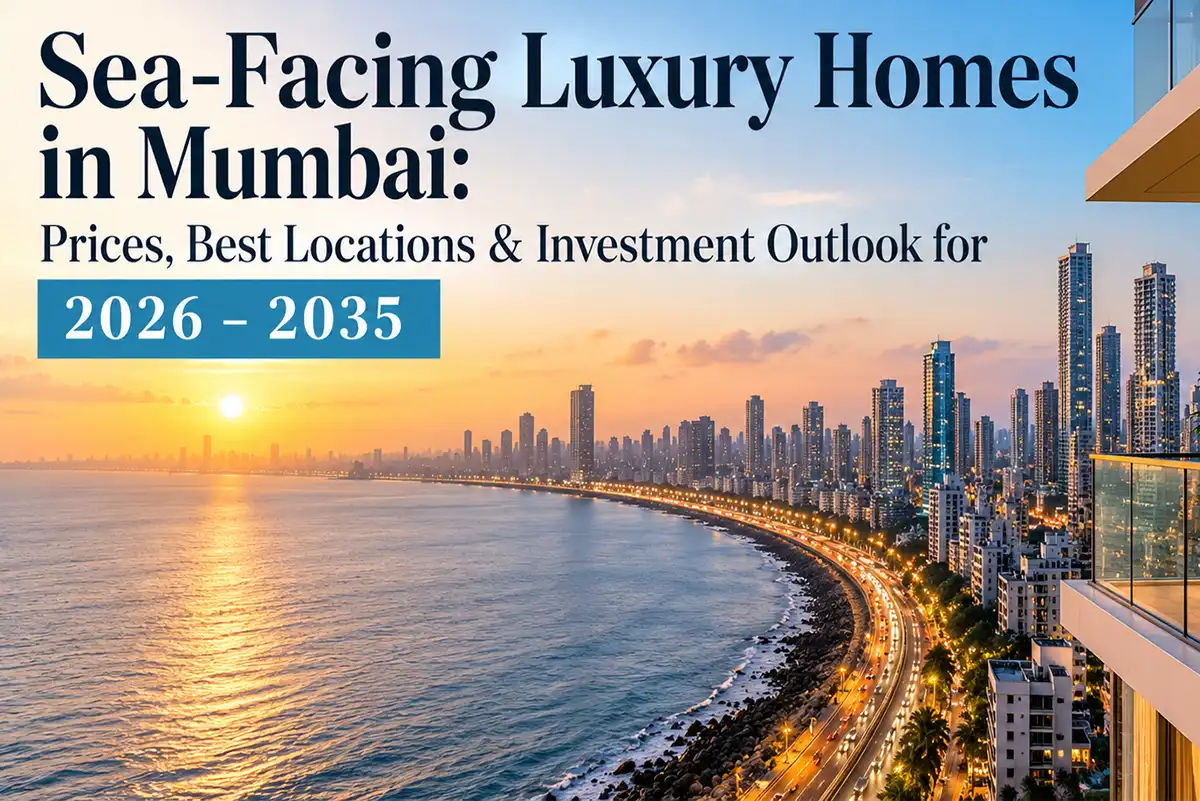
Sea-Facing Luxury Homes in Mumbai: Prices, Best Locations & Investment Outlook
Mumbai’s sea-facing home is the single most defended asset class in Indian real estate. Across eleven coastal micro-markets stretching from Colaba to Madh Island, a structurally fixed shoreline meets an ever-expanding pool of ultra-high-net-worth demand, and the result is a premium that has proven remarkably resistant to broader market cycles.
Sea-facing units in Mumbai now transact at premiums of roughly 25-35% over an equivalent city-facing unit in the same building, comfortably ahead of the premium commanded by garden, golf, river or mountain views elsewhere in India. Worli alone accounts for close to 40% of India’s ultra-luxury housing transactions by value, and single-apartment deals north of ₹100 crore are no longer rare in Worli, Malabar Hill or Bandra.
Four forces define the market today. First, structural scarcity: CRZ regulations, capped FSI in older stock, narrow roads and a shoreline that cannot be extended mean supply additions are almost entirely redevelopment led. Second, infrastructure is compressing distance: the Coastal Road, the Bandra-Versova Sea Link and MTHL are pulling previously peripheral stretches of coastline into the luxury conversation. Third, developer consolidation is underway, with branded coastal collections, Sri Lotus Developers’ eleven-project Luxury Coastline Collection being the clearest example of replacing one-off launches. Fourth, climate change is beginning to price itself into the conversation, though so far as a long-horizon underwriting question rather than a demand deterrent.
Gupta & Sen’s outlook: sea-facing Mumbai real estate will continue to outperform the broader luxury segment through 2035, with the geography of “prime” widening northward from South Mumbai and Worlitoward Bandra, Prabhadevi, Juhu, and over a longer horizon Versova. The report that follows sets out why, where, and for whom.
Why Humans Desire Waterfront Living
Before the real estate, there is the psychology. Waterfront value does not begin with square footage; it begins with a well-documented human response to open water that predates any property market.
Blue Space Theory
Environmental psychologists use the term “blue space” for any visible body of water like sea, river, lake; and a growing body of research links proximity to and views of blue space with lower self-reported stress, improved mood and better perceived general health, echoing the more familiar “green space” findings for parks and forests. Unlike green space, blue space appears to have an added restorative effect tied to the movement, light-reflection and sound of water, which the mind processes as inherently calming.
Biophilic Design and Measurable Wellbeing
Biophilic design i.e., the practice of building human contact with nature into architecture, treats water view, natural light, and ventilation as core design inputs, not amenities. Sea-facing apartments typically deliver all three simultaneously: unobstructed light because there is no opposing structure to block it, cross-ventilation because coastal buildings sit in the path of onshore breezes, and a view with no fixed endpoint, which the eye reads as spacious even in a compact footprint.
- Stress reduction: consistent findings link visible water to reduced cortisol markers and self-reported anxiety
- Sleep quality: unobstructed sea-facing exposure to natural light supports stronger circadian rhythm regulation than deep, light-starved interior units
- Air and acoustic quality: onshore winds dilute pollution load relative to inland, traffic-facing frontage
- Prestige and identity signalling: water frontage has functioned as a wealth marker across cultures and centuries, from Venetian palazzos to Miami’s Star Island
For Mumbai specifically, where the average resident’s daily environment is dense, noisy and visually cluttered, the psychological contrast delivered by an open horizon is amplified. This is the underlying reason the sea-facing premium survives market downturns that compress prices elsewhere: buyers are not only purchasing an apartment, but they are purchasing the one form of visual and sensory relief the city structurally cannot manufacture more of.
Mumbai’s Coastline
Mumbai sits on a peninsula shaped by land reclamation over three centuries, giving it a coastline disproportionately long relative to its land area, commonly cited at roughly 149 km around Greater Mumbai when both the western Arabian Sea frontage and the eastern harbour-facing edge are included.
Western Coastline — the Luxury Spine
The western edge, facing the open Arabian Sea, is where almost the entire luxury residential story plays out: Colaba and Cuffe Parade in the south, through Malabar Hill, Marine Drive, Worli, Bandra, Juhu, Versova and Madh Island moving north. This is unbroken open-sea frontage with sunset orientation, a meaningful driver of the premium discussed in upcoming sections.
Eastern Waterfront — the Coming Story
The eastern edge faces Mumbai’s harbour and the mainland rather than the open sea. It has historically been dominated by port land, naval installations, and industrial uses rather than residential development. The Eastern Waterfront redevelopment, freeing up port-owned land along Sewri, Wadala and the docks, is the most-watched future supply corridor in the city and is discussed further in Section 16.
CRZ and Geography as Co-Authors of the Market
Coastal Regulation Zone rules govern nearly every parcel that touches this shoreline, and Mumbai’s specific geography, a narrow peninsula with limited east-west road depth, compounds the effect of those rules by leaving very little land that is both close to the water and legally buildable at scale. Section 5 covers this constraint in depth.
Evolution of Mumbai’s Waterfront
Mumbai’s luxury address has migrated northward along the coast for over a century, and each migration has followed the same pattern: an area reaches saturation and price ceiling, infrastructure opens the next stretch of coast, and capital moves north in search of the next scarcity.
| Era / Address | What Happened |
|---|---|
| Colonial Bombay | Fort and Malabar Hill establish the template — colonial-era elites choose elevated, sea-facing ground for bungalows and colonial residences. |
| Marine Drive (1920s-40s) | Reclamation creates the Queen’s Necklace; Art Deco apartment blocks become Mumbai’s first organised sea-facing address for the professional elite. |
| Malabar Hill | Remains the enduring gold standard — hilltop elevation plus sea frontage, home to the Governor’s residence and generational South Mumbai wealth. |
| Cuffe Parade | 1970s-80s reclamation opens South Mumbai’s southernmost sea-facing address, popular with old-money and diplomatic residences. |
| Worli | Redevelopment of mill land and older cooperative societies from the 2000s onward turns Worli into the ultra-luxury capital of the 2020s. |
| Bandra | Bandstand and Carter Road bring Bollywood and new-economy wealth to the coast; heritage bungalow stock slowly gives way to redevelopment towers. |
| Juhu | Beach-facing bungalow belt with a film-industry identity, now facing its own generational redevelopment wave. |
| Versova | The current frontier, a fishing-village-adjacent coastline now drawing serious developer attention as Bandra-area land runs out. |
| Luxury Coastline Collection (2026) | Sri Lotus Developers’ eleven-project coastal portfolio spanning Versova to Nepean Sea Road signals the next phase: branded, multi-site coastal collections rather than single towers. |
Why Sea-Facing Homes Are Scarce
Scarcity in this market is not a marketing claim, it is a stack of independent, mutually reinforcing constraints that together cap how much new sea-facing supply Mumbai can ever produce.
- CRZ setbacks: development within defined distances of the high-tide line is restricted or barred outright, removing a meaningful strip of the most valuable land from the buildable envelope
- No new coastline: unlike inland micro-markets, the sea-facing addressable universe cannot expand by rezoning, the shoreline is fixed by geography
- Legacy low-FSI societies: much of the existing sea-facing stock sits in 1960s-80s cooperative buildings built at low Floor Space Index, meaning redevelopment is the only route to new supply and it is slow, consent-dependent and litigation-prone
- Narrow access roads: many coastal stretches (Carter Road, parts of Worli Seaface, Nepean Sea Road) have road widths that cap permissible building height and density regardless of underlying FSI entitlement
- View corridors and setback rules: municipal regulations increasingly protect sightlines to the sea from public roads, constraining how close and how tall a new tower can rise
- Fragmented ownership: sea-facing plots are frequently held by dozens of individual co-operative society members, each of whom must consent before a redevelopment can proceed
The net effect is that new sea-facing supply in Mumbai overwhelmingly arrives through redevelopment of an existing footprint rather than fresh construction on vacant land, which is precisely the model Sri Lotus Developers has built its Luxury Coastline Collection around, with the company noting that all but one of its eleven coastal projects are redevelopment or joint-development ventures.
Mumbai’s Best Sea-Facing Micro-Markets
Eleven coastal addresses define Mumbai’s sea-facing map, each with a distinct history, buyer profile and price band. Indicative resale bands below are Gupta & Sen estimates compiled from listing aggregates and broker inputs as of Q2 2026; actual transaction prices vary by floor, view angle, building vintage and unit specification.
Sea-Facing Micro-Market Price Bands Across Mumbai’s Coastline
| Indicative resale rate range, ₹ ‘000 per sq. ft. (carpet) | |
|---|---|
| Versova | ₹38-58k |
| Madh Island | ₹30-48k |
| Juhu | ₹55-85k |
| Carter Road | ₹62-95k |
| Bandra Bandstand | ₹70-110k |
| Prabhadevi | ₹75-105k |
| Worli Seaface | ₹65-100k |
| Cuffe Parade | ₹70-105k |
| Nepean Sea Rd | ₹85-125k |
| Malabar Hill | ₹90-140k |
| Marine Drive | ₹78-118k |
Gupta & Sen analysis, indicative bands compiled from listing aggregates and broker inputs, Q2 2026
| Micro-Market | Buyer Profile | Price Band* | Outlook |
|---|---|---|---|
| Marine Drive | Colonial legacy, old-money and cultural elite | ₹78k-118k | Art Deco heritage constraints cap redevelopment pace; scarcity value rising as a heritage-protected address |
| Malabar Hill | South Mumbai’s oldest and most enduring elite address; industrialists, diplomats | ₹90k-140k | The benchmark address; hilltop elevation plus sea view keeps it Mumbai’s highest and most defensive price floor |
| Nepean Sea Road | Old-money South Mumbai families, select redevelopment entrants | ₹85k-125k | Quietly rivals Malabar Hill on price; strong redevelopment pipeline as older buildings turn over |
| Cuffe Parade | Diplomats, corporate leadership, legacy South Mumbai wealth | ₹70k-105k | Southernmost address; Coastal Road and reclaimed open space are lifting connectivity and public realm quality |
| Worli Seaface | New-economy wealth, promoters, celebrities; India’s ultra-luxury epicentre | ₹65k-100k | Accounts for close to 40% of India’s ultra-luxury deal value; Coastal Road and Sea Link access are the core catalyst |
| Prabhadevi | Adjacent new-money buyers priced out of Worli | ₹75k-105k | The fastest-rising address in South-Central Mumbai; Sri Lotus and other developers are actively entering here |
| Bandra Bandstand | Bollywood, media, new-economy founders | ₹70k-110k | Iconic address with limited bungalow-to-tower conversion runway remaining; scarcity intensifying |
| Carter Road | Younger HNIs, media and start-up wealth | ₹62k-95k | Narrow-road height caps preserve low-rise character but also cap future supply growth |
| Juhu | Film industry, beachfront lifestyle buyers | ₹55k-85k | Large bungalow plots entering a generational redevelopment cycle; long-term upside market |
| Versova | Value-conscious HNIs, early movers betting on the next up-cycle | ₹38k-58k | The frontier micro-market; Sri Lotus’s coastal collection and metro connectivity are the key re-rating catalysts |
| Madh Island | Weekend-home buyers, longer-horizon speculative capital | ₹30k-48k | Least developed of the eleven; connectivity remains the binding constraint on institutional-grade demand |
*Indicative carpet-area resale rate, ₹ per sq. ft. Gupta & Sen estimates, Q2 2026
Alibaug, the Weekend-Home Comparison
Alibaug sits outside city limits across the harbour but is increasingly discussed alongside Mumbai’s coastline as a second home and weekend-retreat market for the same UHNI buyer pool, aided by improving RoRo ferry links and, longer term, the MTHL. It is a materially different product, low-rise villas rather than high-rise apartments, but it competes for the same wallet share and is worth tracking as a release valve for buyers priced out of Worli or Bandra.
Sea-Facing Premium Analysis
Within the same building and comparable floor tier, view orientation alone moves price meaningfully, and sea-facing commands the largest premium of any view category available in the Indian market.
A sea-facing unit typically commands a 25-35% premium over an identical city-facing unit in the same tower, well ahead of the 10-14% range seen for golf, river or mountain-facing units elsewhere in India, and roughly four times the premium attached to a garden-facing unit. The gap widens further at the top of the market: a nearly 15,000 sq. ft. apartment at Lodha Sea Face in Worli transacted at approximately ₹187 crore, illustrating how the premium compounds rather than flattens as unit size and specification rise.
Three factors explain why the sea premium outpaces every other view category. First, permanence: a sea view cannot be built out by a neighbouring tower the way a garden or golf-course view sometimes can. Second, orientation value: west-facing sea view units capture sunset light, which buyers price distinctly higher than a sea view without sunset exposure. Second, floor-height interaction: the premium is non-linear, it accelerates on higher floors where the view clears intervening structures entirely, meaning the top quartile of floors in a coastal tower can command a disproportionate share of a project’s total revenue.
Mumbai’s Best Sea-Facing Buildings
A representative cross-section of Mumbai’s most significant sea-facing addresses, spanning heritage, current ultra-luxury and pipeline supply. This is illustrative rather than exhaustive of the full top-25 universe a buyer-side mandate would screen.
| Building / Collection | Location | Developer | Why It Matters |
|---|---|---|---|
| Antilia | Malabar Hill | Private residence | Global benchmark for scale and privacy; not for sale but sets the ceiling for the address |
| Lodha Sea Face | Worli | Lodha | Site of a ~₹187 crore unit sale; among the highest per-unit transactions recorded in Worli |
| Oberoi Three Sixty West | Worli | Oberoi Realty | Benchmark tower for institutional-grade ultra-luxury; consistent quarter-on-quarter appreciation |
| Birla Niyaara | Worli | Birla Estates | Newer entrant reinforcing Worli’s position as India’s densest ultra-luxury cluster |
| 25 South | Prabhadevi | Lodha | Marquee address bridging Worli and Prabhadevi’s rising profile |
| Piramal Mahalaxmi | Mahalaxmi | Piramal Realty | Racecourse-and-sea dual-view positioning; strong redevelopment-led design |
| World Towers | Lower Parel / Worli | Lodha | Among the tallest residential towers in the cluster, sea-facing upper floors command a wide premium |
| Rustomjee Sea View / coastal portfolio | Bandra / Khar | Rustomjee (Keystone Realtors) | Consistent western-suburb sea-facing redevelopment focus |
| Sri Lotus Luxury Coastline Collection | Versova, Juhu, Carter Road, Bandstand, Prabhadevi, Nepean Sea Road | Sri Lotus Developers | Eleven-project, ₹8,000-9,000 crore GDV coastal portfolio, the largest single coordinated coastal launch in Indian residential history |
| Ashok Towers-era Worli redevelopments | Worli | Various | Represent the earlier wave of mill-land redevelopment that first established Worli’s luxury identity |
| Bombay Realty coastal projects | Wadala / Eastern Waterfront-adjacent | Bombay Realty | Positioned to benefit disproportionately from Eastern Waterfront redevelopment |
| Kalpataru coastal redevelopments | Bandra, Khar | Kalpataru | Steady western-suburb presence built on cooperative-society redevelopment |
Developer Comparison
Ten developers currently define Mumbai’s coastal luxury landscape, each with a distinct strategy, geographic concentration and redevelopment approach.
Infrastructure Changing the Coast
No single force is re-rating Mumbai’s coastline faster than the current wave of connectivity infrastructure.
Mumbai Coastal Road (Dharmveer Swarajya Rakshak Chhatrapati Sambhaji Maharaj Marg)
The 29.2 km, eight-lane Coastal Road links Marine Drive to the western suburbs. Phase 1 (Marine Lines to Worli, roughly 10.6 km) opened in 2024 and cut travel time on that stretch from around 40 minutes to roughly 10-12 minutes. Phase 2, extending toward Bandra, Versova, Dahisar and ultimately Kandivali, cleared a key CRZ and mangrove-authority approval hurdle in early 2026 and is progressing toward completion. The project also creates roughly 70 hectares of reclaimed open space along the route, adding a public promenade dimension that further lifts adjoining residential value.
Bandra-Versova Sea Link
Extending the existing Bandra-Worli Sea Link northward to Versova, this project is the single biggest reason Versova is now investable rather than purely aspirational, it directly answers the connectivity gap that has historically kept Versova prices well below Bandra and Juhu.
Mumbai Trans Harbour Link (MTHL / Atal Setu)
India’s longest sea bridge connects South Mumbai to Navi Mumbai, materially shortening the journey to Navi Mumbai’s new international airport and unlocking Navi Mumbai and Alibaug as credible extensions of the greater Mumbai coastal luxury and second-home map.
Metro Expansion and BKC Connectivity
Metro corridors reaching Bandra, Juhu-adjacent stretches and BKC are compressing commute times between coastal residential addresses and Mumbai’s primary commercial business district, reinforcing the investment case for buyers who want sea-facing living without sacrificing proximity to work.
Architecture of Waterfront Towers
Designing for Mumbai’s coastline is a materially different discipline from inland high-rise design, and the buildings that command the steepest premiums are the ones that treat the sea as a design input from the structural stage onward, not a marketing afterthought.
- Glass facades: high-performance, low-iron glazing is now standard to maximise clarity of view while managing solar heat gain from unobstructed western exposure
- Wind engineering: coastal towers face materially higher and more sustained lateral wind loads than inland towers of the same height, requiring dedicated wind-tunnel testing and often tuned mass dampers
- Salt corrosion resistance: marine-grade specifications for structural steel, façade fixings and MEP systems are essential, corrosion-driven maintenance is the most common long-term cost overrun in coastal towers built to inland specification
- Orientation and view optimisation: unit layouts increasingly angle living spaces and master bedrooms toward the sea even where the tower’s structural grid does not naturally favour that orientation
- Balcony design: deeper, wind-sheltered balconies are replacing shallow inland-style balconies, since coastal wind speeds otherwise make balcony use impractical above the mid-rise floors
- Structural systems: shear-wall and outrigger systems are common at height to manage both wind load and the softer, often reclaimed soil conditions typical of coastal Mumbai sites
- Podiums, parking and landscape: multi-level basement parking is standard given site constraints, freeing ground-level and podium space for landscape and amenity decks that frame, rather than block, sea sightlines from lower floors
Climate Change
A balanced view of climate risk belongs in every serious coastal real estate report, without sensationalising a genuinely long-time horizon.
Sea level rise and increased storm surge intensity are real, scientifically documented risks for low-lying stretches of Mumbai’s coast, and Mumbai’s municipal leadership has itself flagged that parts of the southern tip could face intensifying flood exposure over multi-decade horizons. This is a genuine consideration for ground-floor and low-elevation coastal assets, and for civic infrastructure more broadly.
For high-rise residential towers specifically, the practical exposure is different from the headline risk. Upper-floor units in modern coastal towers are physically elevated well above any realistic storm-surge inundation level, and CRZ-compliant construction already builds in some setback and elevation buffer. The more relevant near-term risks are ground-floor amenity and parking flooding, insurance cost trajectories, and the pace at which building codes and insurance underwriting begin pricing climate risk explicitly, all manageable through building technology and design rather than being an argument against the asset class.
Mitigation is already visible in newer coastal projects: elevated ground floors and podiums, flood-resilient basement engineering, storm water attenuation, and, at a city level, the Coastal Road’s reclaimed land, which is expected to double as a partial buffer against wave action for the stretch it covers.
Investment Analysis
Sea-facing Mumbai real estate has historically outperformed non-sea-facing comparables on the metrics that matter most to a long-hold investor.
| Metric | Sea-Facing vs. Non-Sea-Facing |
|---|---|
| Capital appreciation | 8-12% annually across recent cycles for luxury coastal stock, per market aggregates; top-tier Worli and Malabar Hill assets have periodically outpaced this |
| Rental demand | Concentrated among expatriate executives, diplomatic missions and short-let luxury demand; thinner volume than mass-market rental but materially higher ticket size |
| Liquidity | Lower transaction volume than mid-market housing, but the buyer pool (UHNI, family offices, NRIs) is less credit-dependent, which shortens deal-close timelines once a genuine buyer is found |
| Resale | Sea-facing units in established addresses (Malabar Hill, Worli, Bandra) resell at a smaller discount to peak pricing than comparable inland luxury stock during down-cycles |
| Scarcity as a hedge | Because supply cannot expand, sea-facing assets behave more like a scarce real asset than a conventional real estate cash-flow instrument, closer in character to fine art or trophy assets than to standard rental property |
Buyer Personas
Demand for Mumbai’s sea-facing homes is not homogenous. Understanding who is buying, and why, shapes both pricing strategy and product design.
| Buyer Persona | What They Prioritise |
|---|---|
| Industrialists & business families | Multi-generational wealth, South Mumbai legacy addresses, view the home as a dynastic asset held for decades |
| Bollywood and entertainment | Bandra, Bandstand, Juhu; value privacy, proximity to industry and lifestyle visibility in equal measure |
| Founders and new-economy wealth | Worli, Prabhadevi; recently liquid capital seeking a status address with modern specification and amenity |
| NRIs | Often purchasing a second home or long-term family anchor; strong preference for RERA-compliant, professionally managed developments and turnkey specification |
| Family offices | Treat the asset as a portfolio diversification and capital-preservation instrument, with a longer underwriting horizon than an end-user buyer |
| CXOs and senior corporate leadership | Value proximity to BKC and improving infrastructure; often trading up from a strong existing inland address |
| Diplomats and consular missions | Concentrated in Cuffe Parade, Malabar Hill and Marine Drive; institutional rather than individual buying pattern |
| Celebrities | Overlap with entertainment persona; heightened weighting on privacy, security and discretion over pure square footage |
Global Comparison
Mumbai’s coastline is frequently benchmarked against the world’s other major waterfront luxury markets, and the comparison is instructive precisely where it is unflattering.
| City | Comparison Point |
|---|---|
| Miami | Purpose-built waterfront towers, resort-style amenity stacks and hurricane-grade engineering standards; Sri Lotus’s own positioning explicitly invokes a ‘Miami-style’ coastal living pitch for its Luxury Coastline Collection |
| Dubai | New-build supply on reclaimed and purpose-planned coastline gives Dubai a scale and design coherence Mumbai’s redevelopment-led model cannot match, though at the cost of Mumbai’s historic character and density |
| Monaco | The closest scarcity analogue globally, a fixed, tiny coastal footprint commanding some of the world’s highest per-square-foot prices, though at a much smaller absolute scale than Mumbai |
| Hong Kong / Singapore | Both combine extreme land scarcity with rigorous planning discipline and strong public waterfront access, an area where Mumbai’s coastal public realm still lags |
| Sydney / Vancouver / Cape Town | Emphasise public beach and harbour access alongside private luxury development, a balance Mumbai’s Coastal Road promenade is beginning to move toward |
| Rio de Janeiro | Closer to Mumbai’s own reality, dramatic natural geography paired with uneven planning discipline and informal settlement adjacency |
Future Supply
Where can new sea-facing supply still realistically emerge, given the constraints set out in Section 5?
- Versova: the clearest near-term redevelopment corridor, directly catalysed by the Bandra-Versova Sea Link and Sri Lotus’s early positioning
- Juhu: large bungalow plots are entering a generational ownership-transfer and redevelopment cycle
- Bandra Bay (formerly Bandra Reclamation): rebranded reclaimed land with meaningful new-build potential once planning approvals mature
- Prabhadevi and Worli: still have redevelopment runway in older cooperative societies, though the easiest sites have already turned over
- Marine Drive redevelopment: constrained by heritage protections but individual building-level redevelopment remains possible over time
- Eastern Waterfront: the single largest medium-to-long-term supply unlock, contingent on the pace of port-land release and rezoning
-
- Navi Mumbai and Alibaug: MTHL-enabled extensions of the coastal luxury map, offering a materially lower entry price for buyers priced out of the western coastline
Gupta & Sen Sea-Facing Index
Gupta & Sen’s proprietary Sea-Facing Index scores each micro-market across eleven weighted dimensions – View Quality, Scarcity, Walkability, Sunset Quality, Connectivity, Investment potential, Privacy, Architecture, Lifestyle, Resale strength, and Developer Credibility – into a single composite score out of 100.
Malabar Hill leads the index on the strength of an unmatched combination of elevation, scarcity and multi-generational buyer credibility, narrowly ahead of Worli Seaface, whose score is weighted up sharply on Investment and Connectivity following Coastal Road completion. Versova and Madh Island sit at the bottom of the current index not because of any quality shortfall in the water itself, but because Connectivity and Developer Credibility scores are still catching up, both dimensions this report expects to re-rate materially once the Bandra-Versova Sea Link opens and the Luxury Coastline Collection projects reach completion.
Risks
| Risk | Description |
|---|---|
| Oversupply in select pockets | Concentrated redevelopment launches (e.g., multiple large coastal collections landing simultaneously) could soften near-term absorption in mid-tier price bands |
| Climate and insurance cost trajectory | Rising reinsurance costs for coastal assets globally could eventually flow through to Indian coastal insurance premiums |
| CRZ policy reversal risk | Regulatory liberalisation has been the trend, but coastal ecology litigation and activism remain an active check on any further FSI or setback relaxation |
| Execution and redevelopment delay | Fragmented cooperative-society ownership structures make consent, litigation and construction timelines the single most common source of project delay in this segment |
| Luxury segment slowdown | Ultra-luxury demand is more macro-sensitive than it appears; a sustained equity market correction or global wealth shock would disproportionately affect ticket sizes above ₹25 crore |
| Affordability ceiling | Even within the HNI buyer pool, the gap between Malabar Hill/Worli pricing and buyer purchasing power has been widening, which could eventually cap absolute price growth at the very top of the market |
| Global macro and geopolitical shocks | Regional geopolitical instability affects overseas HNI capital flows in both directions, a tailwind today, but a risk that can reverse quickly |
Predictions, By 2035
- Waterfront tower count: Gupta & Sen expects the number of large-format (100+ unit) sea-facing towers across Mumbai’s western coastline to roughly double from today’s base, concentrated in Worli, Prabhadevi, Bandra Bay and Versova
- Average PSF: blended sea-facing luxury pricing across the eleven tracked micro-markets is projected to rise at a mid-to-high single-digit CAGR, with South Mumbai addresses growing slower in percentage terms but from a much higher base
- Most expensive suburb: Malabar Hill and Nepean Sea Road are expected to retain the price ceiling through 2035, barring an unforeseen heritage-driven supply unlock
- Most likely emerging location: Versova, on the back of the Sea Link and the Luxury Coastline Collection’s completion cycle
- Future skyline: expect a visibly denser, taller Worli-Prabhadevi cluster, a materially transformed Versova skyline, and the first meaningful residential towers to emerge along the Eastern Waterfront by the second half of this decade
Gupta & Sen Perspective
Is the premium justified? Yes. 25-35% premium sounds steep until it is measured against an asset that cannot be replicated at any price; the psychological, scarcity and status value documented across Sections 2, 5 and 7 of this report are structurally durable, not sentiment driven.
Will sea-facing homes continue outperforming? Gupta & Sen’s view is yes, through at least 2035, though the rate of outperformance will vary sharply by micro-market; South Mumbai will compound steadily from an already-high base, while Worli, Prabhadevi and Versova carry the more explosive near-to-medium-term upside.
Will Bandra overtake Worli? Not on pure price within this decade; Worli’s infrastructure head start and ultra-luxury concentration are too entrenched. But Bandra’s lifestyle and cultural capital give it a durable independent identity rather than a chasing one.
Can Versova become tomorrow’s Bandra? This is the single highest conviction call in this report: yes, and the timeline is shorter than consensus currently assumes, contingent primarily on the Sea Link’s completion.
Will South Mumbai remain king? On price, almost certainly. On growth rate and headline momentum, no, that story now belongs to the western suburbs.
What would Gupta & Sen advise an HNI today? Anchor a portfolio with one legacy South Mumbai asset for capital preservation and prestige, and pair it with one forward-positioned Worli, Prabhadevi or Versova asset for growth, treating the two as complementary rather than substitutable holdings.
Key Takeaways
- Sea-facing homes command a 25-35% premium over city-facing units in the same building, the steepest view premium of any category tracked in Indian real estate
- Scarcity is structural and regulatory (CRZ, fixed shoreline, fragmented ownership), not artificial, which makes it durable across cycles
- Worli accounts for close to 40% of India’s ultra-luxury housing transaction value, but the growth frontier is shifting north to Prabhadevi, Bandra Bay and Versova
- Infrastructure, the Coastal Road, Bandra-Versova Sea Link and MTHL, is the single biggest re-rating catalyst across every micro-market in this report
- Sri Lotus Developers’ eleven-project Luxury Coastline Collection marks a strategic shift from single-tower launches to coordinated, branded coastal portfolios, a template competitors will need to answer
- Climate risk is a long-horizon underwriting question, best addressed through building-level design scrutiny rather than blanket avoidance of the asset class
- Gupta & Sen’s highest-conviction call: Versova is the most under-priced credible bet on this entire coastline today

- Buying a Home Together in India: A Practical Guide to Shared Purchases - October 29, 2026
- Sea-Facing Luxury Homes in Mumbai: Prices, Best Locations & Investment Outlook - October 27, 2026
- Why Invest in Land in Karjat Now - August 21, 2026
Our Agents






Trending Properties
 Oberoi Three Sixty West (7,275)
 Naman Xana (6,223)
 Amarja Hills (4,975)
 Hiranandani Sands (4,803)
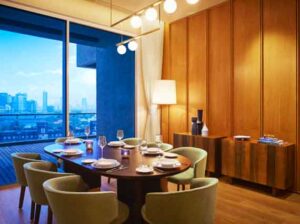 One Avighna Park Lower Parel (4,641)
Latest Properties
The Grand
4 BHK Cannon Building
The Altimus
3 BHK Kalpataru Radiance
3 BHK Amaris Park
Hiranandani Maitri Park


Recent Properties


