Inside Lotus Developers Luxury Coastline Collection
Why Invest in the Luxury Coastline Collection by Lotus
11 Waterfront Projects Reshaping Mumbai’s Coastal Skyline
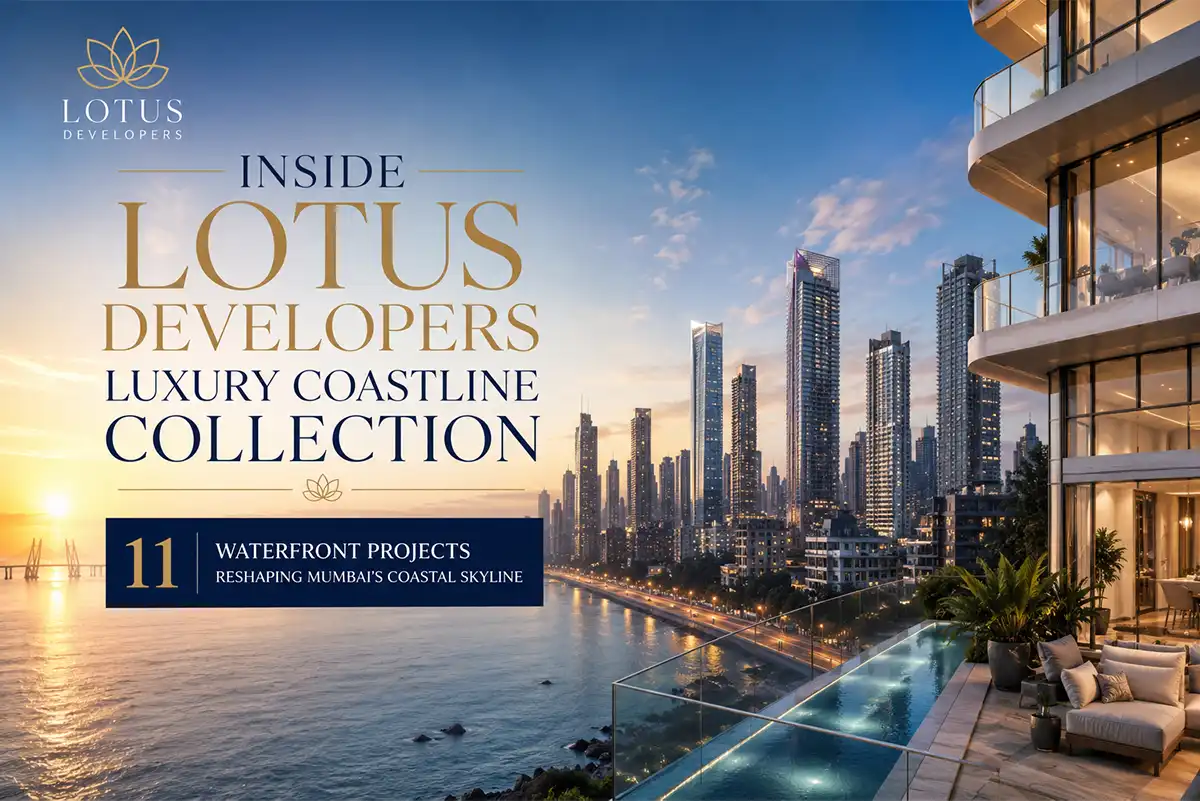
Mumbai’s luxury residential market witnessed a defining moment in April 2026, as Sri Lotus Developers & Realty Limited unveiled the Luxury Coastline Collection: a curated portfolio of 11 ultra-luxury sea-facing residential projects spanning Mumbai’s most coveted waterfront micro-markets. This first-of-its-kind initiative moves decisively beyond standalone project launches, presenting instead a unified, brand-driven approach to coastal living that signals a new chapter in the city’s luxury real estate evolution.
The Collection, announced on 9th April 2026, represents a combined Gross Development Value (GDV) of ₹8,500–10,000 crore (as guided by promoter Anand Pandit in post-launch disclosures; the ₹8,000 crore figure represents the conservative floor estimate), with a planned capital investment of ₹800 crore. Residences are positioned in the ₹10 crore to ₹50 crore range, with per-square-foot pricing spanning ₹80,000 to ₹1,70,000, firmly placing these developments among the highest-value residential assets in the country.
| Projects | GDV | Investment | Timeline | Price Range | PSF Range |
|---|---|---|---|---|---|
| 11 Waterfront | ₹8,000 Crore | ₹800 Crore | 4 Years | ₹10 Cr – ₹50 Cr | ₹80K – ₹1.7L/sqft |
Developer Profile: Sri Lotus Developers & Realty Ltd.
Incorporated in 2015 under its former identity AKP Holdings Limited, Sri Lotus Developers & Realty Limited has carved a distinctive niche in Mumbai’s luxury and ultra-luxury residential segment. The developer’s origins lie in the aspirational micro-markets of Juhu and Andheri West, the addresses that carry a legacy of celebrity homeownership, NRI investment, and sea-view premiums.
Over the past decade, the company has completed four landmark projects aggregating over 4.2 lakh sq. ft. of carpet area, with six ongoing projects and twelve upcoming developments collectively spanning approximately 25.5 lakh sq. ft. of carpet area and 18.7 lakh sq. ft. of saleable area.
Approximately 95% of the portfolio consists of society redevelopment rather than raw land acquisition, a deliberate specialisation that Pandit describes as an entirely different business from conventional real estate development, requiring distinct legal, community, and execution capabilities that most developers do not possess. The company manages the full development value chain, from land acquisition and design to construction, sales, and customer engagement.
A defining competitive edge is the company’s delivery track record: Sri Lotus has consistently completed projects 18 to 24 months ahead of their RERA-committed deadlines, a claim that directly addresses the single greatest anxiety of luxury homebuyers in India. In a market where delays of 2 – 4 years are commonplace, this track record constitutes a material brand differentiator and underpins buyer confidence across the Coastline Collection.
The Luxury Coastline Collection marks its most ambitious strategic move to date: a geographic expansion into premium coastal corridors beyond its home turf, including South Mumbai addresses like Nepean Sea Road and Prabhadevi, as well as Bandra’s iconic Carter Road and Bandstand. The launch also coincides with the developer’s listing on Indian stock exchanges, underscoring the transformation of a boutique luxury developer into a scalable, institutionally structured real estate enterprise.
The BNG Philosophy: Blue and Green
At the core of Sri Lotus’s site selection strategy is what Anand Pandit calls the BNG principle — Blue and Green. Every project in the Sri Lotus portfolio is selected on the non-negotiable criterion that it offers either a premium water view (Blue) or a significant garden/landscape view (Green). This is not a marketing construct but an investment discipline: BNG sites command structural view premiums that are resistant to market cycles, because the view itself, ocean or greenery, cannot be replicated or competed away by adjacent development. The Luxury Coastline Collection is, in its entirety, a BNG portfolio.
Waterfront Portfolio Scale: Competitive Benchmarking
To appreciate the ambition of the Luxury Coastline Collection, it is instructive to benchmark Sri Lotus’s waterfront pipeline against peers active in Mumbai’s premium coastal segment:
| Developer | Waterfront Projects (Active + Pipeline) |
Key Micro-Markets | Positioning |
|---|---|---|---|
| Sri Lotus Developers | 11 (Coastline Collection) | Versova, Juhu, Bandra, Prabhadevi, NSR | Ultra-luxury coastal brand |
| Lodha Group | 4 | Worli, Prabhadevi, Juhu, Marine Lines | Super-luxury / branded residences |
| Rustomjee | 2 | Bandra, Khar | Premium to luxury |
| Oberoi Realty | 1 | Worli (360 West) | Ultra-luxury single landmark |
| Kalpataru | 2 | Thane waterfront, Borivali | Luxury to mid-premium |
| Sunteck Realty | 2 | BKC, Goregaon | Luxury commercial-adjacent |
The Luxury Coastline Collection: Portfolio at a Glance
The 11 projects are distributed across six strategically selected coastal micro-markets, each chosen for its scarcity value, aspirational appeal, and long-term capital appreciation potential. All projects are structured as redevelopment or joint development ventures. Five have received all necessary regulatory approvals with construction actively underway; approvals for the remaining six are anticipated within three months of announcement.
| Location | Sub-Market | Strategic Significance |
|---|---|---|
| Versova | Andheri West | Emerging waterfront node; access to upcoming coastal road |
| Juhu | Andheri West | Lotus stronghold; preferred by Bollywood fraternity & NRIs |
| Carter Road | Bandra West | Iconic promenade; premium sea-view catchment |
| Bandstand | Bandra West | Ultra-prime; highest footfall of HNIs & celebrity buyers |
| Prabhadevi | Central Mumbai | Strategic expansion; growing luxury corridor |
| Nepean Sea Road | South Mumbai | Most exclusive address; capital value >₹1.5L/sqft |
Asset-by-Asset Breakdown
Buyer Personas: Who Buys the Luxury Coastline Collection
Ultra-luxury coastal residences are not purchased for shelter alone. They are expressions of identity, community affiliation, and financial strategy. The Luxury Coastline Collection’s six micro-markets attract six distinct buyer archetypes, each with specific motivations and preferred assets within the portfolio.
Bollywood Celebrity & Entertainment Professional
Juhu and Bandra have historically been the preferred addresses of Mumbai’s entertainment fraternity. Privacy, proximity to studios, and the cultural cachet of these postcodes drive purchasing decisions. Configuration preferences lean toward mid-density towers (15–20 floors) with boutique community sizes, large 4 BHK layouts, and high-end wellness infrastructure.
Likely Projects: Lotus Arcadian (Juhu), Lotus Artemis (Juhu), Lotus Imperial (Carter Road)
NRI Buyer (Diaspora Investor)
NRI buyers, particularly from the US, UK, UAE, and Singapore are drawn to sea-facing residences as a physical anchor to their Mumbai identity, a capital preservation vehicle, and a future retirement or rental asset. The USD-INR differential makes pricing at ₹85K–1.25L/sqft globally competitive. They favour landmark addresses and developer track records over negotiated discounts.
Likely Projects: Lotus Portofino (Versova), Lotus Celestial (Versova Seaface), Lotus Avalon (Bandstand), Lotus Aurelia (NSR)
Startup Founder & Tech Entrepreneur
India’s post-2020 startup liquidity wave has created a new cohort of buyers in the ₹30–45 age bracket with significant liquid wealth. This segment values bare-shell configurations (customisation over plug-and-play), iconic architecture, and proximity to BKC, Lower Parel, and the Bandra-Worli corridor. Trophy homes at Bandstand or Prabhadevi serve as status markers.
Likely Projects: Lotus Avalon (Bandstand), Lotus Odyssey (Bandstand), Lotus Aquaria (Prabhadevi)
CXO / Senior Corporate Executive
C-suite professionals at MNCs and Indian corporates headquartered in Lower Parel, BKC, and Nariman Point seek aspirational residences that reduce commute time while maximising lifestyle amenity. Prabhadevi and South Mumbai addresses score highest on this dual criterion. Configuration preferences are for finished, ready-to-occupy 4 BHK units with managed services.
Likely Projects: Lotus Aquaria (Prabhadevi), Lotus Imperial (Carter Road), Lotus Aurelia (NSR)
Business Family (Second or Third Generation)
Established business families seeking a secondary or primary residence in Mumbai’s most prestigious neighbourhoods. Motivated by legacy, capital preservation, and social signalling. Nepean Sea Road, Bandstand, and Carter Road are aspirational benchmarks. Large-format bare-shell units offer intergenerational customisation. Family offices may acquire multiple units across the Collection for portfolio diversification.
Likely Projects: Lotus Aurelia (NSR), Lotus Avalon (Bandstand), Lotus Imperial (Carter Road), Lotus Aquaria (Prabhadevi)
Family Office & Institutional Investor
Single-family offices and HNI investment vehicles increasingly view ultra-luxury Mumbai real estate as an inflation hedge and capital appreciation asset. The scarce inventory model, developer’s debt-free structure, and CRZ-constrained supply create a compelling alternative asset case. Bulk acquisition of bare-shell floors for lease/sale arbitrage is an emerging institutional strategy.
Likely Projects: Lotus Aquaria (Prabhadevi): bare-shell floors; Lotus Odyssey (Bandstand): large-format units
Market Context: WHY NOW?
The launch of the Luxury Coastline Collection is timed with acute precision. India’s luxury housing market has expanded significantly through 2024–2026, driven by a surge in Ultra High Net Worth Individual (UHNI) wealth, elevated NRI remittances and investment appetite, and a structural shift in aspirational spending post-pandemic, where the home has become the primary expression of social and financial status.
Within Mumbai specifically, demand for exclusive sea-facing residences has been outpacing supply, as waterfront land becomes increasingly finite under CRZ constraints. Simultaneously, Mumbai’s luxury market has seen the emergence of branded residences as a new benchmark for premium living. Sri Lotus’s Coastline Collection responds to the same underlying consumer psychology: the desire for exclusivity, international design standards, and a coherent lifestyle ecosystem rather than a mere housing unit.
Knight Frank India reported a 7% decline in Mumbai housing sales in Q1 2026, which paradoxically creates favourable conditions for discerning ultra-luxury launches. Inventory is scarce at the top of the market, serious buyers are active, and the developer’s strong cash position and debt-free model insulate it from demand-side volatility that tends to affect mid-market projects far more acutely.
Financial Architecture & Investment Framework
The financial structure underpinning the Luxury Coastline Collection reflects a mature, disciplined approach to capital deployment. With an aggregate GDV of ₹8,000 crore against a planned investment of ₹800 crore, the implied cost-to-GDV ratio of approximately 10% speaks to the efficiency of the redevelopment-led model. Sales inflows from early-stage buyers, combined with the company’s existing cash reserves of approximately ₹1,000 crore, are expected to self-fund construction across the portfolio without recourse to external debt or equity dilution.
The Investment Score evaluates ultra-luxury residential assets across eight parameters, each rated on a 1 – 5 scale. Parameters are drawn from Gupta & Sen’s broader India Luxury Residential Assessment Framework, adapted here for Mumbai’s coastal micro-market context.
1. Land Scarcity (CRZ-constrained waterfront)
Mumbai’s Coastal Regulation Zone notification (2019) prohibits new construction within 50 metres of the high-tide line and imposes stringent height and density controls across all six micro-markets in this portfolio. The supply of developable waterfront parcels is effectively fixed. No new land is being created; only redevelopment unlocks new supply. Rated maximum.
2. Developer Brand & Track Record
Sri Lotus has a demonstrated delivery record in Juhu and Andheri West with four completed projects and a decade of operations. The stock exchange listing adds institutional accountability. One point withheld because national brand recognition remains below peers like Lodha or Oberoi, and the Coastline Collection is the developer’s first foray into South Mumbai and Bandra at this scale — execution in new geographies carries inherent uncertainty.
3. Capital Appreciation Potential
The combination of CRZ-constrained supply, Mumbai’s deepening UHNI wealth pool, infrastructure tailwinds (Coastal Road, metro expansion), and the portfolio’s positioning across six micro-markets creates a structural case for above-market appreciation. Historical data from Bandstand and Nepean Sea Road shows 3 – 4% appreciation over 10-year holding periods. Rated maximum.
4. Connectivity & Infrastructure Pipeline
The Western Coastal Road is operational, directly benefiting Versova, Juhu, and Bandra nodes. Metro Line 2A serves Andheri West. Planned metro extensions will further improve catchment. One point withheld because Nepean Sea Road and Prabhadevi remain car-dependent, and last-mile connectivity to coastal promenades is still below global benchmarks.
5. Liquidity (Resale Market Depth)
Ultra-luxury resale markets in Mumbai are thin by nature — the buyer pool at ₹10 – 50 crore is finite, and transaction velocity is compared to mid-market assets. Bandra and Juhu have historically shown better resale liquidity than Prabhadevi or NSR. Portfolio-wide, resale depth is moderate; investors should plan for 12 – 24 month exit timelines rather than immediate liquidity.
6. Rental Yield Potential
Ultra-luxury sea-facing apartments in Mumbai yield 1.5 – 2.5% gross on current market values — structurally low because capital values have appreciated faster than rental growth. Most buyers in this segment are owner-occupiers or capital appreciation investors, not yield seekers. Rated moderate; not a disqualifier but not a return driver.
7. Financial Structure (Debt-free, cash-backed)
The developer’s balance sheet carries approximately ₹1,000 crore in cash, zero external debt, and a cost-to-GDV ratio of ~10% through the redevelopment model. Construction is funded entirely through internal accruals and sales inflows. This is among the most conservative financing structures Gupta & Sen has assessed for a portfolio of this scale. Rated maximum.
8. Execution Confidence (Approvals in hand)
Five of eleven projects hold all regulatory clearances with active construction. The remaining six are pending approvals expected within three months. Rated high but not maximum, reflecting the inherent unpredictability of Mumbai’s regulatory environment and the complexity of managing 11 simultaneous redevelopment sites.
Investment Score: Luxury Coastline Collection
Financial Guidance: Management Targets (FY27)
In post-listing disclosures and media interactions, promoter Anand Pandit has provided the following financial guidance for the company:
At current market capitalization, the implied forward price-to-earnings multiple compresses significantly from trailing levels, a valuation dynamic that institutional investors tracking the stock will find material. The shift in project mix toward higher-PSF coastal addresses (from a ₹60,000/sq ft blended average last year toward the ₹85,000–1,50,000+ range of the Coastline Collection) is the primary driver of both margin expansion and revenue acceleration in management’s guidance.
STRENGTHS
• Proven track record in Juhu & Andheri West
• Only developer with 11 simultaneous waterfront projects
• Redevelopment model minimises land cost exposure
• Stock exchange listing adds institutional credibility
WEAKNESSES
• Execution risk across 11 simultaneous sites
• Limited brand recognition vs Lodha or Oberoi nationally
• Dependence on sea-facing premium sustainability
• Boutique scale limits procurement leverage
OPPORTUNITIES
• New metro lines expanding luxury buyer catchment
• Branded residence JV potential with global hospitality
• NRI demand at 10-year high; USD-INR favourable
• CRZ scarcity driving long-term price floors
THREATS
• Construction cost inflation eroding margins
• Mumbai luxury market Q1 2026 sales down 7%
• Competing super-luxury launches by Lodha, Oberoi
• Monsoon & coastal infrastructure disruption risks
Risk Assessment: Balanced Perspective
A credible investment analysis requires candid acknowledgement of downside risk alongside opportunity. The Luxury Coastline Collection carries several risks that institutional and individual investors should evaluate carefully before committing capital.
| Risk Category | Description | Mitigation |
|---|---|---|
| CRZ Policy Risk | Regulatory tightening of Coastal Regulation Zone norms could stall or invalidate approvals for projects in early stages | 5 projects already approved; CRZ policy largely stable since 2019 notification |
| Execution Concentration | Managing 11 simultaneous construction sites poses significant project management, procurement, and labour resource risk | Redevelopment model reduces site complexity; developer has 10-year delivery track record |
| Luxury Market Moderation | Mumbai luxury sales declined 7% in Q1 2026; sustained slowdown could delay absorption | HNI/NRI buyers are rate-insensitive; ultra-luxury segment shows lower cyclicality than mid-market |
| Construction Cost Inflation | Materials and labour costs have risen 12–18% since 2022; margin compression is a real risk in fixed-price JDA structures | Debt-free model and ₹1,000 Cr cash balance provides significant buffer; input cost hedging advisable |
| Redevelopment Complexity | JDA structures involve incumbent tenants, society members, and legal approvals that can cause delays of 12–24 months | Early approval clearances on 5 projects reduce near-term exposure; standard risk for all Mumbai redevelopment |
| Sea-View Premium Sustainability | Coastal Road, new high-rises, and climate risks could erode the sea-view premium over time | CRZ height restrictions limit overshadowing; premium has held across 3 price cycles in these micro-markets |
| Market Concentration Risk | All 11 projects are in Mumbai; a city-specific shock (infrastructure failure, regulatory change) affects the entire portfolio | Geographic spread across 6 micro-markets provides partial hedge within the Mumbai market |
Gupta & Sen Forecasts: 2026–2030 Outlook
Based on our analysis of Mumbai’s luxury residential cycle, the developer’s financial positioning, and infrastructure tailwinds, Gupta & Sen makes the following projections for the Luxury Coastline Collection:
Outlook & Gupta & Sen Perspective

- Inside Rustomjee’s Premium Portfolio: How the Developer Is Redefining Luxury Living in Mumbai - July 19, 2026
- Inside Lotus Developers Luxury Coastline Collection - July 7, 2026
- The Future of Branded Residences in India - June 23, 2026