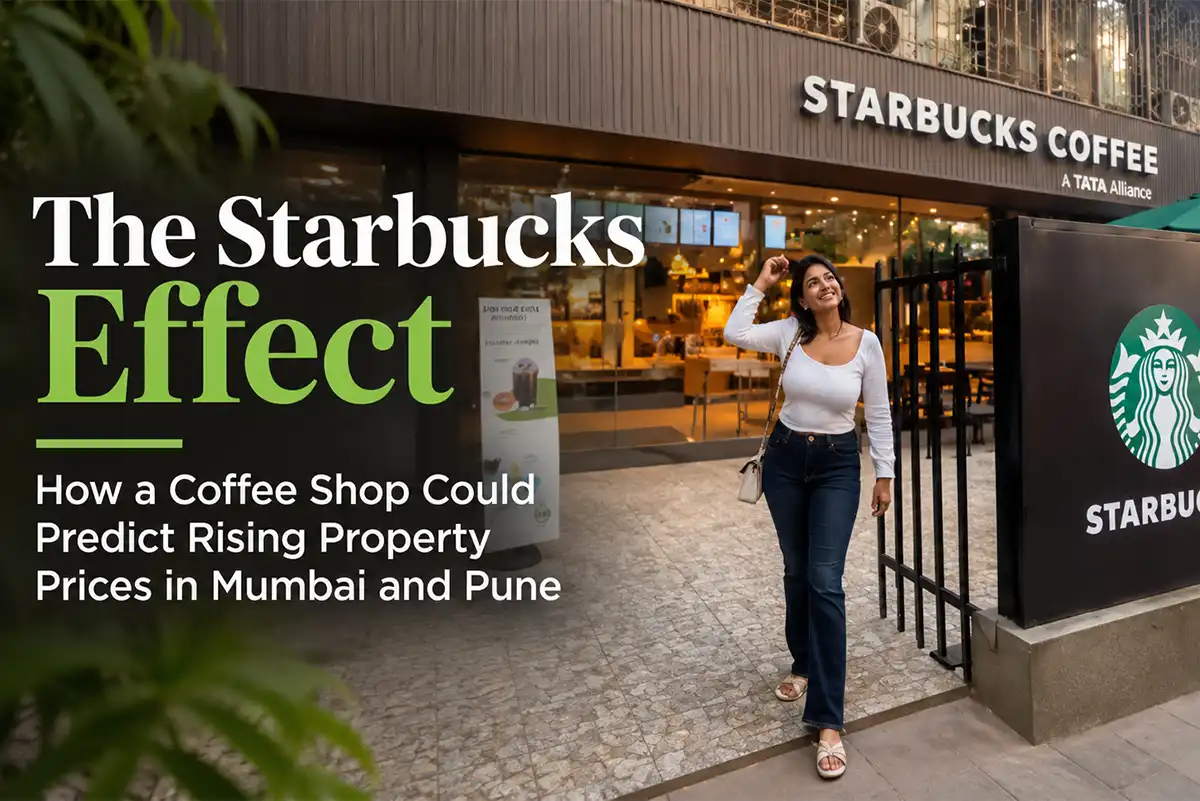
The Starbucks Effect: How a Coffee Brand Can Predict Rising Property Prices
What if one of the more intriguing indicators of a neighbourhood’s future property values was not a proposed metro station, a new expressway or a luxury residential development, but a coffee shop? Not just any coffee shop, either: the one with the familiar green mermaid logo.
From Mumbai’s historic Fort district and fashionable Bandra to Pune’s leafy Koregaon Park and rapidly evolving neighbourhoods of Kharadi, Balewadi and Wakad, Starbucks’ expanding footprint tells an interesting story about the changing economic geography of both cities.
International research suggests that Starbucks correlates with something considerably more valuable than coffee: rising home values. More intriguingly, the evidence suggests that Starbucks may be helping fuel, rather than merely following, that appreciation. Could the same phenomenon be unfolding in Mumbai and Pune?
1. Starbucks and Venti-sized property appreciation
In their 2015 book, Zillow Talk: Rewriting the Rules of Real Estate, Spencer Rascoff and Stan Humphries examined historical American housing values in relation to Starbucks locations. They compared homes within a quarter mile (approximately 400 metres) of a Starbucks with the wider residential market.
In 1997, a typical home in an area that would subsequently have a Starbucks nearby was worth approximately $137,000, compared with $102,000 for a home outside such locations. By approximately 2014, the broader market had appreciated 65%, while Starbucks-adjacent homes had appreciated 96%, nearly doubling in value.
The Starbucks Effect on Home Values
| Property category | Home value in 1997 | Subsequent home value | Appreciation |
|---|---|---|---|
| Typical American home | $102,000 | $168,000 | 65% |
| Home near Starbucks | $137,000 | $269,000 | 96% |
Source: Zillow Talk: Rewriting the Rules of Real Estate (2015).
The difference of 31 percentage points is particularly interesting because properties near Starbucks were already more expensive at the beginning of the period. They did not merely command higher prices; they subsequently appreciated faster. For investors, the implication is that the retail businesses choosing to enter a neighbourhood may deserve attention alongside infrastructure, employment and historical property prices.
2. Is Starbucks the fuel, not the follower?
Perhaps Starbucks simply identifies wealthy neighbourhoods. Its customers have the disposable income to pay a premium for coffee, so rising property values might attract the company rather than the other way around. The Zillow researchers examined this possibility by comparing Starbucks with another major American coffee chain, Dunkin’ Donuts.
Initially, homes near both chains followed similar historical trajectories, outperforming the broader market. Both groups experienced greater volatility during the housing downturn, but during the recovery Starbucks-adjacent properties pulled ahead.
Starbucks vs. Dunkin’ Donuts: Property Appreciation
| Residential property category | Historical appreciation |
|---|---|
| Overall American housing market | 65% |
| Properties near Dunkin’ Donuts | 80% |
| Properties near Starbucks | 96% |
Source: Zillow Talk: Rewriting the Rules of Real Estate (2015).
Could the difference simply reflect Starbucks’ concentration in affluent coastal cities or urban areas? To address this objection, the researchers compared two rings around individual stores: homes within 400 metres and homes between approximately 400 and 800 metres. They measured appreciation during the five years after each store opened.
Homes in the inner ring appreciated slightly more than 21%, compared with slightly less than 17% in the outer ring. These properties shared much of the same neighbourhood infrastructure, employment access and local economic conditions. The result is consistent with Starbucks contributing to appreciation, although it does not conclusively establish causation.
Further evidence emerged in 2018 when economists Edward Glaeser, Hyunjin Kim and Michael Luca published Measuring Gentrification: Using Yelp Data to Quantify Neighborhood Change. Their research associated an additional Starbucks in an American ZIP code with approximately 0.5% higher residential property prices. Growth in Starbucks reviews was also associated with stronger price growth. Changes in local retail activity appeared to provide useful information about neighbourhood transformation.
Together, these studies suggest that Starbucks may be both a perceptive observer of rising neighbourhoods and an active participant in their evolution. Whether the same relationship holds in India is a question worth investigating.
3. Starbucks in India: Reading the real estate map
Starbucks entered India through its partnership with the Tata Group on 19 October 2012, opening its flagship outlet in the Elphinstone Building at Horniman Circle, Mumbai. Oberoi Mall in Goregaon and the Taj Mahal Palace Annexe in Colaba were also among its inaugural locations. On 8 September 2013, the company opened its first Pune outlet in Koregaon Park.
These choices reveal a preference for established commercial destinations, affluent residential communities and premium lifestyle environments. Subsequent expansion into technology corridors, integrated townships and emerging suburban markets offers a different perspective: some outlets indicate where wealth already exists, while others may indicate where new wealth is being created.
4. The Starbucks Effect in Mumbai
Mumbai’s limited land availability, concentration of corporate wealth and sophisticated luxury housing market make neighbourhood desirability particularly important. Premium retail is one component of the lifestyle for which residential buyers are willing to pay.
Fort and Colaba: Established wealth
The Horniman Circle flagship occupies the historic financial district, surrounded by banking institutions, corporate establishments and colonial architecture. In 2022, Starbucks established its first Indian Reserve store at its original location. Along with its presence near the Taj Mahal Palace in Colaba, this illustrates the company’s ability to recognise established wealth and cultural significance while contributing to the revival of historic commercial districts as experiential destinations.
Bandra West: Lifestyle becomes real estate value
The outlet at Vinco Apartments on Chapal Road in Bandra Reclamation serves a neighbourhood known for coastal promenades, celebrity residences, boutiques, restaurants and internationally oriented households. Here, cafés function as informal offices, social destinations and extensions of the home. A luxury apartment buyer is paying not only for the residence but also for access to this urban lifestyle. Affluent residents attract premium brands, which in turn help attract more affluent residents.
Worli and Lower Parel: Industrial land to luxury living
The Century Bhavan outlet near Century Bazaar places Starbucks within Worli’s luxury residential corridor. Former industrial properties have given way to high-rise residences, corporate offices and hotels. Premium cafés reinforce the internationally oriented lifestyle that complements these developments. Knight Frank’s H2 2025 research reported 7% annual price growth in its tracked Worli segment, with prices of approximately ₹88,734–₹95,354 per sq. ft.
Lower Parel provides another example of urban regeneration. Starbucks established outlets in the Phoenix Mills retail environment and celebrated its 100th Indian store at Victoria Mills in Kamala Mills in 2017. Rather than choosing a traditional luxury residential address, it invested in a former industrial district undergoing commercial transformation. Knight Frank reported 4% annual price appreciation in its tracked Lower Parel segment in H2 2025. Neither figure can be attributed directly to Starbucks, but both illustrate the overlap between premium retail and valuable residential markets.
Goregaon, Juhu, Santacruz and Andheri West
Oberoi Mall’s inclusion among the first Indian Starbucks locations is especially interesting. Goregaon was not traditionally considered comparable to South Mumbai or Bandra in luxury positioning, but premium integrated developments, offices, shopping and affluent residential communities gradually changed its identity. Starbucks recognised the purchasing power of this suburban ecosystem early in its Indian expansion.
In Juhu, Santacruz West and Seven Bungalows in Andheri West, Starbucks serves established affluent populations, including entertainment industry professionals and entrepreneurs. Its presence reinforces the premium character of these markets rather than necessarily identifying entirely new ones.
Mumbai’s Starbucks Locations and Their Real Estate Significance
| Starbucks location | Real estate significance |
|---|---|
| Horniman Circle, Fort | Established financial and heritage district |
| Taj Mahal Palace vicinity, Colaba | International hospitality and established luxury |
| Chapal Road, Bandra West | Affluent, lifestyle-oriented residential market |
| Century Bhavan, Worli | Ultra-luxury residential transformation |
| Phoenix Mills, Lower Parel | Mixed-use regeneration and luxury retail |
| Victoria Mills, Kamala Mills | Commercial and lifestyle reinvention |
| Oberoi Mall, Goregaon | Premium suburban residential ecosystem |
| Advent Neel, Juhu | Established affluent residential neighbourhood |
| RNA Classic Building, Santacruz West | Premium residential and commercial catchment |
| Seven Bungalows, Andheri West | Entertainment industry and affluent suburban housing |
5. The Starbucks Effect in Pune
Pune offers a particularly interesting opportunity to examine the phenomenon because its technology-led economy has created new concentrations of residential wealth. Neighbourhoods once considered peripheral have become aspirational addresses, and Starbucks’ expansion provides a lens through which to observe this change.
Koregaon Park and Aundh: Reinforcing established affluence
Pune’s first Starbucks opened at Galaxy Gardens on North Main Road in Koregaon Park in 2013. The neighbourhood was already cosmopolitan, with leafy streets, spacious bungalows, restaurants and international residents. Much like Bandra West, its identity extends beyond the housing stock itself. Knight Frank’s H1 2025 research reported 7% annual appreciation in its tracked Koregaon Park segment, with prices of approximately ₹16,206–₹19,501 per sq. ft.
The outlet at Centriole on ITI Road in Aundh similarly serves an established affluent residential community. Premium cafés, restaurants and wellness establishments strengthen its lifestyle appeal.
Balewadi High Street: The making of a lifestyle destination
Starbucks near Laxman Nagar High Street serves the Baner–Balewadi corridor, which has evolved from peripheral suburban development into a sought-after destination for technology professionals, business owners and affluent families. Restaurants, cafés, fitness establishments and other lifestyle businesses have helped redefine its identity.
The important question is whether this commercial environment merely responds to existing spending power or subsequently attracts additional affluent households. The relationship plausibly works in both directions: growing wealth attracts premium brands, which help create a more desirable residential environment.
This reinforcing cycle is the essence of the Starbucks Effect.
Kharadi: Following the geography of new wealth
The Kharadi MIDC outlet serves a major technology and commercial employment corridor. Multinational businesses and global capability centres generate demand for housing among educated professionals. Premium cafés provide meeting spaces for executives, entrepreneurs and business visitors. In such markets, purchasing power may be growing faster than the neighbourhood’s historical reputation, making Starbucks a visible signal of otherwise less visible demographic change.
Hadapsar, Magarpatta, Amanora and Viman Nagar
Outlets at Amanora Park Town and Seasons Mall illustrate the integrated township effect. Combining housing, employment, shopping and entertainment creates convenience that can influence residential preferences, rental demand and resale liquidity. In Viman Nagar, Starbucks at Phoenix Marketcity serves a cosmopolitan catchment benefiting from airport proximity, educational institutions and employment centres. Mall outlets may reveal the purchasing power of a wider catchment rather than a direct price premium within walking distance.
Wakad and Hinjawadi: Emerging residential wealth
Starbucks on Kala Khadak Road in Wakad and within the Rajiv Gandhi Infotech Park corridor in Hinjawadi is especially interesting from a forward-looking investment perspective. Unlike Koregaon Park, these markets developed primarily through technology employment, migration and new housing. Premium international brands reflect changing consumer expectations and may help these neighbourhoods progress from employment-linked residential locations into more sophisticated lifestyle destinations.
Pune’s Starbucks Locations and Their Real Estate Significance
| Starbucks location | Real estate significance |
|---|---|
| Galaxy Gardens, Koregaon Park | Established premium lifestyle market |
| Centriole, ITI Road, Aundh | Mature affluent residential community |
| Balewadi High Street | Emerging premium lifestyle destination |
| Kharadi MIDC | Technology-led residential wealth creation |
| Phoenix Marketcity, Viman Nagar | Premium retail and cosmopolitan catchment |
| Amanora Park Town, Hadapsar | Integrated township housing demand |
| Seasons Mall, Magarpatta vicinity | Employment-linked residential ecosystem |
| Kala Khadak Road, Wakad | Emerging affluent suburban community |
| Rajiv Gandhi Infotech Park, Hinjawadi | Technology-driven residential expansion |
| Old Mumbai–Pune Highway, Pimpri | Evolving urban consumer catchment |
6. Are property prices rising in Pune’s Starbucks neighbourhoods?
Knight Frank’s H2 2024 residential market research reported the following annual price movements across selected Pune micro-markets.
Annual Property Price Appreciation in Pune’s Residential Micro-Markets
| Pune residential micro-market | Annual price appreciation |
|---|---|
| Kharadi | 8% |
| Hinjawadi | 8% |
| Baner | 7% |
| Koregaon Park | 6% |
| Wakad | 6% |
| Aundh | 1% |
| Hadapsar | 1% |
Source: Knight Frank, India Real Estate – H2 2024. Figures represent broader residential micro-market appreciation, not Starbucks-specific property returns.
These figures describe broader neighbourhoods, not individual homes immediately adjacent to Starbucks. The overlap between premium coffee locations and growing residential markets is intriguing, but the variation matters too. A mature market may appreciate more slowly than an emerging employment corridor despite having higher absolute property values. Starbucks is a useful potential indicator, not a guarantee of exceptional returns.
7. Why Starbucks could help fuel property appreciation
Brand validation is one mechanism. An international company signing a commercial lease, investing in interiors and establishing an operating business is making a financial commitment based on anticipated consumer demand. Its decision may reveal purchasing power and demographic changes not yet fully reflected in property market perceptions.
Starbucks also provides a third place outside the home and workplace. In dense cities, a comfortable space to meet friends, work remotely or conduct informal business can have genuine lifestyle value. It makes the neighbourhood more functional and enjoyable, particularly for younger professionals and internationally mobile households.
Successful premium cafés can also attract complementary businesses: gourmet bakeries, speciality restaurants, premium grocers, wellness establishments and boutique fitness studios. As these accumulate, an ordinary residential area may develop a distinctive lifestyle identity. The appearance of streets, quality of commercial establishments and atmosphere of a neighbourhood influence how buyers perceive it and what they are willing to pay.
For luxury buyers, these considerations can be especially significant. Corporate tenants, expatriates and professionals relocating to Mumbai or Pune may also favour neighbourhoods offering familiar conveniences. While premium retail does not guarantee higher rental yields, it can contribute to sustained demand and long-term marketability.
8. Is it Starbucks, coffee shops or urbanisation?
The American Dunkin’ Donuts comparison suggests that Starbucks may have distinctive predictive characteristics. In India, a comparable study would need to examine Blue Tokai, Third Wave Coffee, Tim Hortons, Costa Coffee and independent speciality cafés. These businesses also serve affluent consumers and may signal changing neighbourhood demographics.
Starbucks is particularly interesting because its international recognition, standardised operating environment and institutional location-selection process provide a relatively consistent reference point across markets. However, the brand’s relative predictive advantage in India remains untested.
Another explanation is that Starbucks simply operates in economically successful urban areas. Coastal Mumbai’s geographical advantages and Pune’s technology employment corridors generate residential demand independently of coffee shops. Researchers would need to control for these factors to isolate any additional Starbucks effect. Nevertheless, an investment indicator need not be the primary cause of growth to be useful. Starbucks can anticipate growth generated by other factors and subsequently contribute to the lifestyle transformation sustaining it.
9. Choosing locations: An art and a science
During the Zillow investigation, the researchers visited Starbucks’ Seattle headquarters and met Arthur Rubinfeld, who oversaw its location-selection process. At the time, approximately twenty analytics specialists internationally examined geographical information systems, maps, traffic flows and surrounding businesses. Regional teams supplemented the analysis with local knowledge and made decisions about locations and store design.
A premium retailer may consider population density, household purchasing power, corporate employment, pedestrian and vehicular traffic, complementary businesses, future development, visibility, accessibility, commercial viability and local consumer behaviour. The combination of data and judgement is especially relevant in Mumbai and Pune, where neighbouring residential pockets can differ considerably.
The process is not infallible. The original researchers noted a Seattle commercial location where anticipated growth failed to materialise around the financial crisis. Even sophisticated companies occasionally misjudge the future. The lesson for homebuyers is to combine objective evidence with an understanding of how people want to live.
10. How the effect could be tested in Mumbai and Pune
A local study could identify Starbucks opening dates and compare registered residential transactions within 400 metres, between 400 and 800 metres, and beyond 800 metres in comparable areas. Researchers would examine price trends before and after openings, including the subsequent five years wherever data permits.
The analysis should account for building age, developer reputation, apartment size, specifications, metro connectivity, employment growth, redevelopment and available housing supply. High-street outlets should be distinguished from malls, office campuses and townships. Comparable studies of competing coffee chains could help establish whether any observed premium is specific to Starbucks or reflects broader neighbourhood upgrading.
Until such property-level evidence is available, the American findings should not be interpreted as a forecast of Indian appreciation rates.
11. What property investors can learn from Starbucks
Alongside infrastructure, developer activity and employment prospects, investors should examine the changing consumer geography of a neighbourhood. Are increasingly affluent households moving in? Are premium international brands, speciality cafés, restaurants and lifestyle businesses opening? Can residents conveniently walk to these destinations? Is the transformation already reflected in property prices?
In Mumbai, Bandra West, Juhu and Worli already command substantial premiums. Starbucks reinforces their appeal, but much of that appeal is priced in. In Pune, Koregaon Park represents established prestige, while Balewadi, Kharadi, Wakad and Hinjawadi illustrate different stages of emerging residential wealth. The opportunity may lie in identifying neighbourhoods where premium lifestyle infrastructure is arriving before property prices fully reflect the transformation.
There are important exceptions. Airport outlets, highway food courts and isolated office campuses may reveal little about residential desirability. Excessive housing supply, poor civic infrastructure, traffic congestion or declining employment can undermine appreciation despite premium retail. Immediate proximity to a busy café can also bring noise and parking problems, while neighbourhood upgrading may put pressure on existing residents and independent businesses. Starbucks should complement, not replace, comprehensive property due diligence.
12. Conclusion: The next Starbucks and the next property hotspot
The next time Starbucks opens in Mumbai or Pune, consider why the company chose that particular neighbourhood. What does it anticipate about future purchasing power? Who are the residents it expects to serve? Is the area already established, or is it becoming something more valuable?
American research demonstrates a meaningful historical association between Starbucks proximity and home-value appreciation, with evidence consistent with the company helping fuel neighbourhood transformation rather than simply following it. Mumbai and Pune possess many characteristics that make this hypothesis worth investigating: emerging employment corridors, increasing affluence, sophisticated consumer demand and the transformation of peripheral locations into aspirational addresses.
Starbucks may follow wealth into a neighbourhood, but once established, it can help reinforce the lifestyle environment that attracts additional wealth. Residential values ultimately reflect not only the quality of homes themselves but also the quality of the lives people can lead around them.
For discerning investors, there may be considerably more to that familiar green logo than meets the eye. The next time Starbucks sets up shop in an emerging neighbourhood, it might be worth exploring the surrounding residential properties before the wider market discovers what makes the area special.
After all, the most valuable thing Starbucks serves its customers may not always come in a coffee cup!
Research sources and references
Zillow Talk: Rewriting the Rules of Real Estate (2015), Spencer Rascoff and Stan Humphries. https://www.zillow.com/research/starbucks-home-value-appreciation-8912/
Measuring Gentrification: Using Yelp Data to Quantify Neighborhood Change (2018), Edward L. Glaeser, Hyunjin Kim and Michael Luca. https://www.nber.org/papers/w24952
Tata Starbucks corporate announcements: https://www.tataconsumer.com/
Starbucks India official store directory: https://stores.starbucks.in/
Knight Frank — India Real Estate: Office and Residential Market, H2 2024, H1 2025 and H2 2025.
Editorial note: The Indian store locations and local market figures have not been independently reverified in this article. The local examples are illustrative, not a property-level causal study.

- The Starbucks Effect: How a Coffee Brand Can Predict Rising Property Prices - November 25, 2026
- Should You Buy a Vacation Rental Property in India? - November 6, 2026
- Buying Land to Build a Second Home? What to Check Before You Pay - November 3, 2026