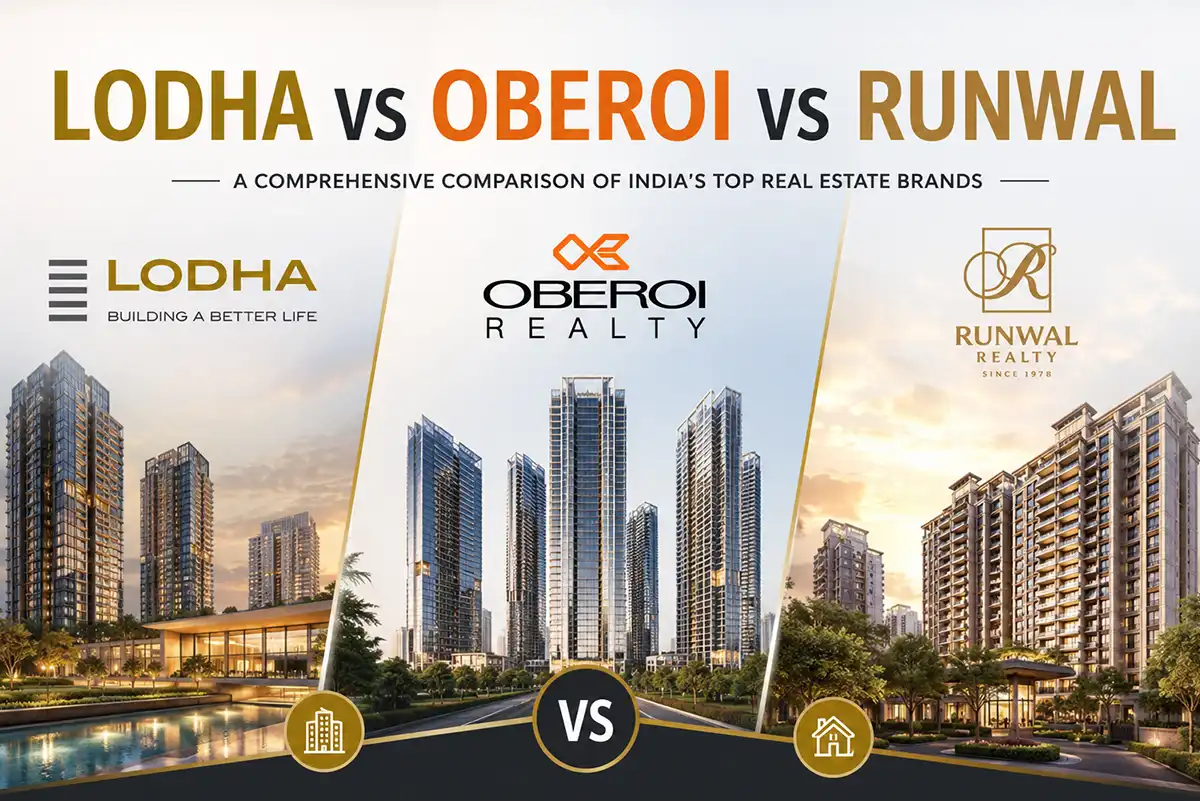
LODHA vs OBEROI vs RUNWAL
Gupta & Sen Intelligence Report #001
A Comparative Analysis of Project Design, Density & Urban Quality
Gupta and Sen Intelligence Report | Mumbai Residential Real Estate | 2026
Methodology
This analyses 100 residential projects across three major Mumbai developers. Lodha Group (47 projects), Oberoi Realty (24 projects), and Runwal Realty (29 projects). Projects span Mumbai city, Mumbai’s western suburbs and eastern suburbs, and the Thane metropolitan extension, covering the full portfolio range from ultra-luxury towers to mid-segment communities and large townships, at all stages of delivery.
| Developer | Projects | Key Locations |
|---|---|---|
| Lodha | 47 | Worli, BKC, Lower Parel, Andheri West, Thane, Vikhroli, Goregaon, Mulund, Borivali |
| Oberoi Realty | 24 | Andheri West, Goregaon East, Borivali, Mulund, Santacruz, Juhu, Thane, Worli |
| Runwal | 29 | Worli, Parel, Santacruz, Andheri, Chembur, Ghatkopar, Mulund, Thane, Deonar |
Data Sources
Four source categories were used, with findings triangulated wherever possible.
1. Developer Brochures & Sales Materials: Primary source for amenity lists, unit configurations, and tower heights.
Limitation: Marketing documents; may overstate quality or understate density.
2. MahaRERA Plan Filings: Used for unit counts, FSI data, and passage widths; carries legal accountability.
Limitation: Not all projects had accessible filings; approved drawings may diverge from actual construction.
3. Google Earth: Spatial analysis of site layouts, setbacks, open space, and ground-plane conditions.
Limitation: Measurements carry an estimated 10–15% margin of error.
4. IGBC / LEED Certification Records: Green building ratings cross-referenced against IGBC’s public project registry.
Limitation: Certification status may change as ratings expire or projects are reassessed.
Introduction
Mumbai’s luxury and mid-segment residential markets are dominated by three powerhouse developers — Lodha Group, Oberoi Realty, and Runwal Realty. Each has carved a distinctive identity across the city’s most coveted micro-markets, from the sea-facing enclaves of Worli and Lower Parel to the rapidly expanding corridors of Thane and Goregaon.
This report offers a critical analytical lens through which we evaluate their projects across eight key parameters: layout planning, density, circulation, amenity programming, urban integration, ventilation strategy, walkability, and project efficiency.
The analysis draws on data from 47 Lodha projects, 24 Oberoi Realty projects, and 29 Runwal Realty projects spread across Mumbai and its extended metropolitan region. Taken together, these 100 projects represent a significant cross-section of how private developers are shaping the city’s built environment — for better and for worse.
Layout Planning
Lodha’s portfolio exhibits the most pronounced stratification in layout philosophy. At the ultra-luxury end – Lodha Marq in Tardeo, Lodha Cullinan in Worli, and the Lodha Altamount — the developer adopts a low-density podium-and-tower typology with generous setbacks, landscaped ground planes, and deliberate sky breaks between towers. Passage widths in these projects range from 1.8 to 4.0 metres, and FSI utilisation is pushed to the 45–55% range, reflecting intelligent deployment of permissible FAR without cramming the site.
In contrast, Lodha’s township projects such as Upper Thane, Amara, and Splendora follow a more regimented grid layout that prioritises unit count over spatial quality. Here, passage widths narrow to 1.5 metres and FSI utilisation drops to the 20–30% range, suggesting underuse of ground-plane potential.
Oberoi Realty has established the most consistent layout language across its portfolio. The Goregaon East cluster — including Esquire, Exquisite, Elysian, Seven, Woods, and Garden City — collectively forms a de facto neighbourhood with interconnected podium levels, a shared retail spine, and coordinated landscaping. Passage widths average 1.5 – 1.8 metres in this cluster, and the internal coherence of the layouts speaks to long-term master planning rather than ad hoc site-by-site decisions.
Runwal’s layout approach is more transactional. The majority of Runwal projects follow a standard tower-on-stilts model with centrally positioned amenity podiums. Runwal’s Worli project Runwal Reserve, is a notable exception, featuring larger passage widths and a sky clubhouse that anchors the vertical composition. Their Thane townships, however, reveal a pattern of repetitive building placement without meaningful response to site topography or microclimate.
| Parameter | Lodha | Oberoi Realty | Runwal |
|---|---|---|---|
| Passage Width (Luxury Tier) | 1.8–4.0 m | 1.8–2.5 m | 1.8–4.0 m (top tier only) |
| Passage Width (Mid Segment) | 1.5 m | 1.5 m | 1.5 m |
| FSI Utilisation (Luxury) | 45–55% | 35–50% | 45–55% |
| FSI Utilisation (Township) | 20–30% | 25–35% | 20–30% |
| Layout Consistency | High (luxury), Medium (township) | High across tiers | Low–Medium |
Density
Density in Mumbai’s residential projects is best understood not merely through unit counts, but through the relationship between built mass and open ground. Lodha’s ultra-luxury developments — such as World One, World Crest, and Cullinan — achieve dramatic heights of 75-plus floors while preserving expansive ground-level open spaces, effectively managing density through verticality.
Oberoi Realty’s Goregaon master plan, particularly Oberoi Garden City with its 80-acre site area, manages density more intelligently than any of the three developers. By integrating schools, retail, and recreational infrastructure within a single cohesive precinct, density is moderated through amenity layering rather than reliance on raw open space alone. The 25-acre Sky City development in Borivali East follows a similar township model.
Runwal’s density profile is comparatively uneven. Its multiple Thane township phases — including Garden City, Regency, Pearl, and Eirene — accommodate substantial populations on site areas ranging from 30,000 to 50,000 square metres. The repetition of near-identical building forms with limited density relief suggests a density-first approach that may compromise long-term liveability.
Circulation
The internal movement network of a residential project is a revealing indicator of design quality. All three developers employ the standard lift-and-staircase model for vertical circulation, but the scale of provision varies meaningfully.
Lodha’s premium projects provide up to six lifts per tower, as seen in Cullinan, while their mid-range developments typically offer three to four lifts. Oberoi Realty’s luxury projects, including Three Sixty West and Elysian, match this standard with five to six lifts, while their mainstream offerings generally provide three to four lifts.
Runwal’s lift provision across most projects ranges from three to four lifts per tower, with five lifts appearing only in Runwal Reserve at Worli. Staircase widths remain largely consistent across all three developers, averaging 1.5 metres in the mid-market segment and increasing to 1.8 metres in premium developments.
The more significant circulation gap emerges at the ground plane. Lodha’s township projects and Runwal’s Thane developments often feature underdesigned pedestrian pathways that are shared with service vehicles. Oberoi Realty’s Goregaon campus performs strongest in this regard, offering dedicated pedestrian spines, segregated vehicular loops, and level-change ramps that support residents across all mobility levels.
| Metric | Lodha | Oberoi Realty | Runwal |
|---|---|---|---|
| Max Lifts (Luxury) | 6 (Cullinan) | 6 (Three Sixty West) | 5 (Reserve) |
| Standard Lift Count | 3–4 | 3–4 | 3–4 |
| Staircase Width (Luxury) | 1.8 m | 1.8 m | 1.8 m |
| Ground-Plane Ped. Network | Strong (luxury), Weak (township) | Strong (campus projects) | Moderate |
| Service vs. Resident Separation | Yes (luxury), Partial (mid) | Yes (Goregaon campus) | Partial |
Amenity Planning
Amenity programming is where Lodha differentiates itself most aggressively. Flagship developments such as Cullinan, World Crest, World One, and Lodha Altamount offer private theatres, grand ballrooms, Olympic-sized swimming pools, spas, sky clubs, athletics tracks, and cricket grounds. This level of amenity provision is unmatched in the Mumbai market and effectively creates private members’ clubs within residential developments. Lodha Park further sets a benchmark by incorporating a large private park as its central amenity.
Oberoi Realty’s amenity strategy is defined by quality over quantity. Elysian in Goregaon East features a sky clubhouse, landscaped gardens, spa, and mini theatre — a curated collection of amenities that avoids the scale of Lodha’s ultra-luxury offering while delivering high utility per square foot. The Garden City and Sky City townships further distinguish themselves by integrating schools and retail infrastructure as part of a live-work-play ecosystem, representing a more sophisticated approach to urban programming than either Lodha or Runwal achieve within their township developments.
Runwal’s amenity offering is functional but rarely distinctive. Most projects provide a conventional combination of clubhouse, swimming pool, and gymnasium, with amphitheatres and jogging tracks appearing in larger developments. Runwal Reserve stands apart as an exception, featuring a spa, private dining facilities, and a sky clubhouse that approaches the premium standards established by Oberoi Realty.
Urban Integration
Urban integration — defined as the extent to which a project connects with and enriches its surrounding neighbourhood — varies considerably across all three developers, reflecting the broader industry preference for gated, inward-looking communities.
That said, location remains a major determinant of urban integration. Lodha’s Worli cluster benefits from proximity to IKEA, Phoenix Palladium, the Four Seasons Hotel, and the Bandra-Worli Sea Link, creating a concentration of urban amenities that cannot be replicated through development strategy alone. Similarly, Lodha’s BKC project, Evoq, is situated within Mumbai’s financial district, providing a high degree of natural urban integration by virtue of its location.
Oberoi Realty’s Goregaon cluster is arguably the strongest performer in terms of intentional urban integration. Proximity to Oberoi Mall, Film City, and NESCO IT Park creates a compelling live-work-leisure ecosystem, while the Garden City master plan has evolved into a genuine sub-neighbourhood within Goregaon East.
Runwal’s Chembur developments benefit from the presence of R-City Mall and connectivity via the Eastern Freeway, while its Mulund projects integrate reasonably well with R Mall and Nirmal Lifestyle. However, none of Runwal’s projects demonstrate a significant effort to contribute to street life, activate the public realm, or embrace transit-oriented design—representing a missed opportunity given the scale of the developer’s footprint across the Mumbai Metropolitan Region.
Ventilation
Ventilation performance in high-rise residential projects is determined by tower orientation, cross-ventilation provision within units, floor-plate depth, and facade openability. The dataset evaluates ventilation primarily through proxy metrics, most notably the percentage of glazed or open facade reported across individual projects.
The ventilation figures represent the Window-to-Wall Ratio (WWR) — the proportion of the exterior wall area occupied by glazing. These estimates are derived from facade drawings, elevation plans, and published architectural renderings.
Lodha’s premium developments report facade ventilation ratios ranging from 40–55%, with Lodha Cullinan and the Lodha Altamount residences occupying the upper end of this spectrum. The zero-discharge design strategies employed at Cullinan and World Crest also suggest a greater reliance on sealed, mechanically conditioned environments, highlighting a trade-off between sustainability certifications and natural cross-ventilation.
Oberoi Realty demonstrates the most consistent ventilation performance across its portfolio, with reported ratios ranging from 30–50%. Three Sixty West achieves 50–60%, the highest range recorded in the dataset. The developer’s Goregaon projects generally cluster between 30–40%, a reasonable outcome given the larger floor plates typically associated with township-scale developments.
Runwal’s ventilation performance broadly mirrors Oberoi Realty’s mid-range projects, with ratios between 25–40%. Its premium developments in Worli and Nepean Sea Road reach 45–55%. Runwal Serene in Deonar, however, reports a ventilation range of only 25–35% alongside a walkability score of 1.5 — the lowest recorded in the dataset — suggesting a project that prioritises plot efficiency over environmental quality and pedestrian experience.
| Developer | Luxury Tier Ventilation | Mid Segment Ventilation | Notable Outlier |
|---|---|---|---|
| Lodha | 45–55% | 30–40% | Cullinan: 45–55% |
| Oberoi Realty | 40–60% | 30–40% | Three Sixty West: 50–60% |
| Runwal | 45–55% | 25–35% | Serene Deonar: 25–35% (lowest) |
Walkability
Walkability is assessed through average footpath width, with scores ranging from 1.5 to 3.0 metres across the dataset. A score of 3.0 metres represents a comfortable pedestrian environment capable of accommodating two-way foot traffic and a planting strip, while a score of 1.5 metres effectively functions as a single-file path that is unsuitable for families or wheelchair users.
Lodha’s luxury developments in Worli, BKC, and premium South Mumbai locations consistently achieve walkability scores of 3.0, reflecting the quality of their surrounding public realm. Their mid-market and Thane township projects generally score between 2.0 and 2.5, indicating adequate but largely unremarkable pedestrian infrastructure.
Oberoi Realty delivers the most consistent performance across its portfolio. Projects in Andheri East, Goregaon, and Santacruz typically score between 2.0 and 2.5, while Three Sixty West in Worli achieves a score of 3.0. The Goregaon campus particularly benefits from an internal pedestrian network that compensates for the relatively car-oriented nature of the surrounding streetscape.
Runwal records the weakest walkability performance among the three developers. Most of its Thane township projects score around 2.0, with several developments in Chembur and Ghatkopar posting similar results. The Deonar project scores just 1.5, indicating a pedestrian environment that is poorly suited for everyday walking activity. Runwal Reserve and The Residence at Nepean Sea Road are notable exceptions, both achieving scores of 3.0 due to their premium locations and higher-quality surrounding urban environments.
Project Efficiency
Project efficiency encompasses green building certifications, water management, energy performance, and waste treatment systems—the key metrics that determine long-term operational costs and environmental impact.
Lodha holds the largest number of IGBC-certified projects within the dataset, with Lodha Cullinan and the Lodha Altamount Road residences achieving Platinum certification, while multiple Worli developments hold IGBC and LEED Gold ratings. The zero-discharge design philosophy implemented at Lodha Cullinan and World Crest, combined with 100% wastewater treatment, reflects a genuine commitment to closed-loop water management that extends beyond conventional certification requirements. Rainwater harvesting (RWH) and solar power systems are nearly universal across the Lodha portfolio, while Sewage Treatment Plants (STPs) are commonly incorporated into larger township developments.
Oberoi Realty has the highest concentration of IGBC-certified projects relative to the size of its portfolio. Seven developments hold Platinum certification, including Three Sixty West (LEED Platinum), Splendor Grande, Elysian, Eternia & Enigma, Garden City (Thane), Sky City, and Oberoi Garden City Goregaon. This represents a standout achievement and reinforces Oberoi Realty’s position as the sustainability leader among the three developers.
Runwal’s efficiency credentials are competent but less distinguished. IGBC Gold certification is present at Runwal Reserve and The Residence, while the majority of its mid-market developments are limited to rainwater harvesting and solar power systems. No Runwal project within the dataset achieves Platinum certification. Its Thane townships incorporate Sewage Treatment Plants across multiple phases, establishing a solid sustainability baseline. However, the absence of more ambitious certification targets represents a missed opportunity given the scale and prominence of the developer’s township portfolio.
| Efficiency Metric | Lodha | Oberoi Realty | Runwal |
|---|---|---|---|
| IGBC Platinum Projects | Cullinan, Altamount (2) | 7 projects | 0 |
| IGBC Gold Projects | Multiple (Worli, BKC cluster) | Multiple | Reserve, Residence (2) |
| Zero-Discharge Design | Yes (Cullinan, World Crest) | Yes (Three Sixty West) | No |
| RWH Adoption | Near-universal | Near-universal | Near-universal |
| STP in Townships | Yes | Yes | Yes |
| Solar Power | Widespread | Widespread | Widespread |
AND THE WINNER IS…….
Each developer occupies a distinct niche within Mumbai’s residential ecosystem, making different trade-offs between design quality, sustainability ambition, and commercial pragmatism.
Lodha leads in amenity programming and luxury design language. Its flagship developments are genuine architectural statements that set the benchmark for high-rise residential living in Mumbai. However, its township projects tend to be more formulaic, and the walkability and ground-plane quality of several suburban developments leave considerable room for improvement.
Key Finding
Oberoi Realty emerges as the most consistent performer across all eight evaluation parameters. Its Goregaon campus demonstrates the potential of coordinated, phased master planning, creating a coherent neighbourhood rather than a disconnected collection of towers. The developer’s sustainability credentials are the strongest within the dataset, while its approach to urban integration — particularly through Oberoi Garden City and the strategic positioning of projects near transit and retail anchors — reflects a long-term commitment to neighbourhood quality.
Runwal occupies the middle ground between mass-market delivery and aspirational development. Its premium projects in Worli and Nepean Sea Road meet luxury-market benchmarks, but much of the broader portfolio prioritises delivery efficiency and unit economics over design quality, walkability, and advanced sustainability certification. As homebuyers become increasingly discerning and environmental standards continue to tighten, this gap may evolve into a competitive disadvantage.
Ultimately, the developer that builds the best cities is not necessarily the one with the tallest towers or the most elaborate amenity lists. It is the one that creates the most liveable ground plane, prioritises pedestrian movement, integrates effectively with urban infrastructure, and takes environmental performance seriously. By these measures, Oberoi Realty holds a narrow advantage, though the industry as a whole still has significant progress to make.
Final Scorecard
| Developer | Design Quality | Walkability | Urban Integration | Sustainability | Density Management | Circulation | Overall |
|---|---|---|---|---|---|---|---|
| Lodha | 9/10 | 7/10 | 8/10 | 8/10 | 7/10 | 7/10 | 7.7 |
| Oberoi | 8/10 | 8/10 | 9/10 | 10/10 | 8/10 | 8/10 | 8.5 |
| Runwal | 6/10 | 5/10 | 6/10 | 5/10 | 5/10 | 6/10 | 5.5 |
Scores derived from report data across 100 projects. All assessments are based on desk research; no site visits conducted.
Scores derived from report data across 100 projects. All assessments based on desk research; no site visits conducted.

- Inside Rustomjee’s Premium Portfolio: How the Developer Is Redefining Luxury Living in Mumbai - July 19, 2026
- Inside Lotus Developers Luxury Coastline Collection - July 7, 2026
- The Future of Branded Residences in India - June 23, 2026